

 NEWS
NEWS INDUSTRY NEWS
Fortunately, Nord Drivesystems had just the thing, kicking off a partnership that has since spread across all the juicer manufacturer's new equipment.
From Spray Pumps to Citrus
JBT Marel traces its roots to 1884, when inventor John Bean developed a continuous spray pump to combat scale in his California almond orchards. The company that grew from his invention—John Bean Technologies—became JBT Marel in January 2025 after its merger with the Icelandic food-processing leader Marel, making it a global provider of equipment, software, and services for the food and beverage industry. In fact, its technology touches nearly every aisle of the supermarket, from poultry, meat, and seafood to prepared foods, dairy, and beverages.
In Lakeland, though, citrus rules. The company's industrial extractors process roughly 75 percent of the world's orange juice, and the same patented whole-fruit extraction principle used in those machines—developed in the 1930s and refined ever since—powers every Fresh’n Squeeze juicer. That technology helps Fresh’n Squeeze systems maximize the juice squeezed from each fruit while producing clean, great-tasting juice, bringing decades of citrus-processing expertise to retail and foodservice environments.
Ricky Negrón, Nord’s district sales manager based in Clearwater, FL, supports JBT Marel and picks up the story of how the two companies met. “The original equipment was using a competitor’s gearmotor, but when that supplier moved away from single-phase in 2017, JBT had a real need on its hands,” he says. "The biggest obstacle back then was size. The machine was small, and the gearmotor was installed in a very tight cavity, so you needed a gearbox that would not only work but also fit in the available space. Nord had one, and that's really what opened the doors for us."
Wade Roberts, mechanical design engineer for Fresh’n Squeeze at JBT Marel, was there at the start. “We were redesigning our mid-sized Multi-Fruit Juicer, or MFJ, when we learned our existing supplier was moving away from single-phase motors,” he says. “That prompted us to evaluate alternatives, and the Nord motor looked like a strong fit for the application, and from there, we’ve established a great relationship. We’ve long since begun using Nord in all our new equipment designs.”
Maximizing Value
To appreciate what those gearmotors are up against, it helps to understand how a Fresh’n Squeeze machine works. Most competing juicers use a cut-and-press design that slices the fruit in half, then pushes each half against a rotating press. It’s a simple, inexpensive approach, but one with consequences for flavor. “You’re pressing on the entire orange, which means you get most of the oil on the peel’s surface,” Roberts explains.
In JBT Marel's whole-fruit extraction process, a pair of specially shaped cups encase the fruit, peel and all. A cutter opens a small hole in the bottom of the orange, and as the cups close, the fruit's contents are forced through the hole into a strainer tube. A plunger then compresses everything into a volume measuring roughly an inch across, ejecting the juice through the tube's tiny perforations—ranging from 0.028 in. to 0.055 in. in diameter—while the seeds, membrane, and excess pulp exit separately. The result is clean juice free of oil-induced bitterness, and up to 50 percent more juice per fruit than cut-and-press machines can deliver. That combination of flavor and yield is one of the key advantages of the Fresh’n Squeeze platform, helping operators maximize the value of every piece of fruit while delivering a premium consumer experience.
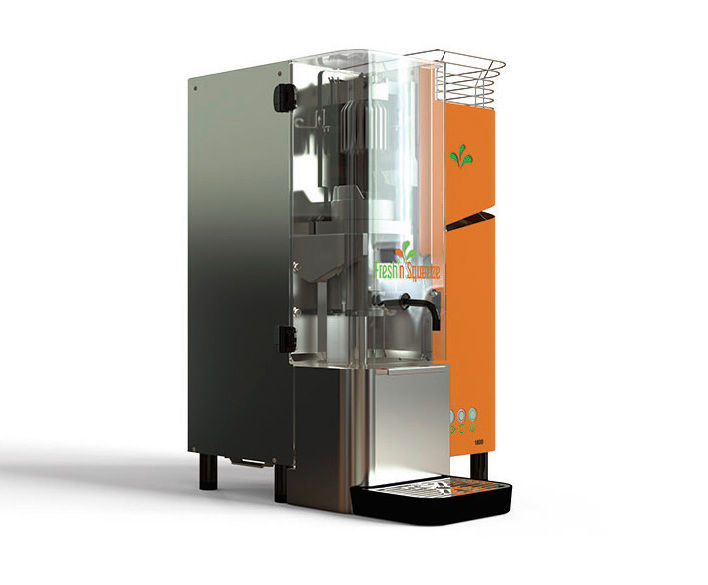
Better yet, one set of components handles everything. “Lemons, limes, grapefruit, oranges, tangerines, mandarins—any kind of citrus you can think of is juiced with the same set of components,” Roberts points out. “The only thing we change is the strainer tube, and that just controls how much pulp you want in the juice.”
The 1800 is the smallest machine in the Fresh’n Squeeze lineup, sitting below the mid-sized MFJ. It processes up to 18 fruits per minute, yielding 50 ounces of juice, and accepts fruits up to 3.25 in. in diameter. Operators simply load the hopper, which holds around 20 pounds of fruit, and press a button. And with just six removable parts, each hose down safe, cleanup is equally easy.
Driving it all is a Nord SMI worm gearmotor with a three-phase 1 hp motor, while the MFJ, found in Sam's Club stores nationwide, carries a 1.5 hp version of the same right-angle drive. Both operate on a variable frequency drive (VFD), an arrangement that gives each machine multiple speed settings and earned the company an unexpected piece of intellectual property.


