

 NEWS
NEWS INDUSTRY NEWS
In addition to John Crane’s contribution, other Smiths Group businesses supported the Artemis II mission. Flex-Tek supplied highly engineered components for the Orion SLS, including rigid tubing used for the safe transfer of fuel, gas and hot air within the rocket’s main propulsion and air systems. Smiths Interconnect contributed high-speed cable assemblies and connectors critical to mission communications.
“Product reliability and integrity was absolutely key to the success of these components and everyone across the company knew what was at stake once the mission launched in April,” Huizinga added.
Across the Finish Line
The day of the mission there were nerves around the office. Huizinga said team members were paying close attention to the television as well as the skies above. Some engineers watched the launch take place on television while others patiently waited for live updates from NASA.
On the second day of the mission, NASA reported that Orion had performed a 5-minute, 49-second trans-lunar injection burn using the European service module’s (ESM’s) AJ10 main engine. This was the only use of the main engine during the mission; subsequent maneuvers were conducted by the eight smaller R-4D secondary engines. The burn consumed approximately 1,000 lbs. (450 kg) of hypergolic propellant and placed the spacecraft on a free-return trajectory around the Moon, requiring only minor course corrections for the remainder of the mission.
By the sixth day, Orion had entered the Moon’s sphere of influence and was officially 252,756 miles from Earth (beating the previous record held by Apollo 13).
On day ten, Orion conducted an 8-second trajectory correction burn, the final firing of the ESM prior to reentry. NASA confirmed that the mission had consumed less than half of the fuel aboard the ESM. After the separation, the thrusters on the crew module fired for 19 seconds to push it away from the ESM and put it into the proper angle for reentry. Astronauts Christina Koch, Victor Glover, Jeremy Hansen, and Reid Wiseman returned to Earth safely on April 11, 2026.
Everyone involved in the Artemis II project at John Crane was keen to share the news of the successful mission.
“We have some nice samples and a display at one of the German plants that tells the story of how John Crane participated in the Artemis II project,” Huizinga said. “I think all the different companies involved in the mission were extremely relieved and proud of their contributions to a project of this size and scope.”
Ruben Alvarez, president of John Crane, said: “Artemis II is a powerful example of what’s possible when deep engineering expertise, innovation and collaboration come together. At John Crane, we are proud to contribute specialized technologies alongside our colleagues across Smiths Group, helping enable a mission that pushes the boundaries of performance, reliability, and human exploration.”
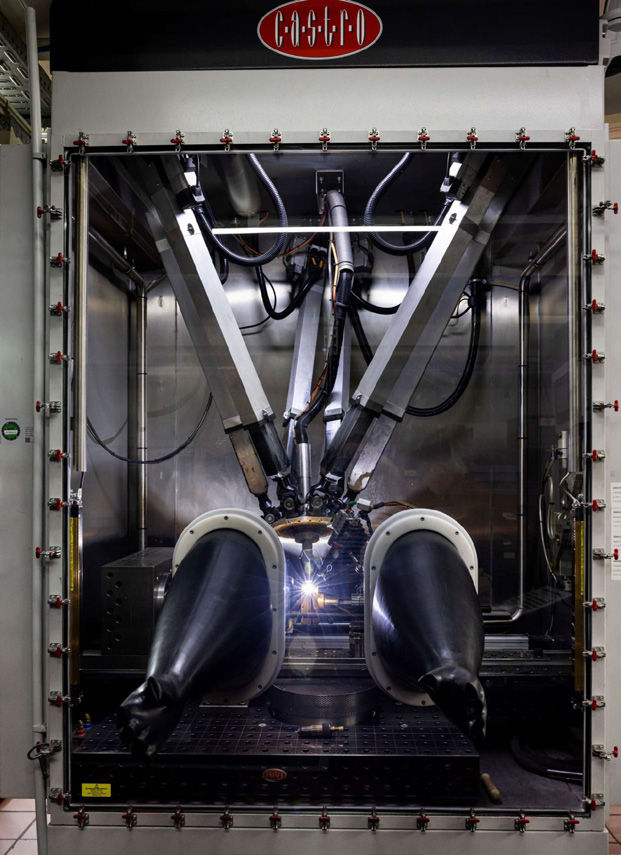
“Every piece of equipment for this kind of spacecraft needs to undergo a demanding qualification and acceptance program. During the sieve development phase, we had to combine the extensive sieve manufacturing expertise from John Crane with the space engineering know how of ArianeGroup. John Crane has proven to be a dependable supplier for such critical elements, and we are looking forward to continuing our cooperation,” said Dr. Nicolas Fries, Orion propellant tank development lead at ArianeGroup.
What Comes Next
Huizinga believes Artemis III will be a continuation of the work John Crane has provided for earlier Artemis missions. During Artemis III, the SLS rocket will launch the Orion spacecraft and its crew to low Earth orbit and demonstrate rendezvous and docking capabilities with test versions from commercial human landing systems in development by Blue Origin and SpaceX. This mission is set to take place in 2027.
The company continues to collaborate with the ArianeGroup on filtration technology for other aerospace projects. The Smiths Group is also working on projects with the Indian space program.
The time and effort—not to mention the paperwork—needed to make the filtration technology work for Artemis II is something John Crane can celebrate for years to come.
Artemis II marked a historic step in inclusive space exploration and set a new human-distance record from Earth, inspiring global attention, and confidence in NASA’s Artemis program. The mission bridged the gap between Apollo-era lunar exploration and the next generation of human spaceflight. The success of this operation will help NASA and other space agencies prepare a detailed roadmap for additional lunar missions as well as eventual missions to Mars.
“We played just a small role in a critical aerospace project and I’m always curious to know what they learned from the mission and what advancements will be applied to future space projects,” Huizinga said. “The engineering and manufacturing capabilities alone, it’s mind-blowing when you step back and think about it.”


