Welcome to Sino Bearings web
24x7 HOTLINE:+86-28-81454188


 TECHNOLOGY
 PRODUCTS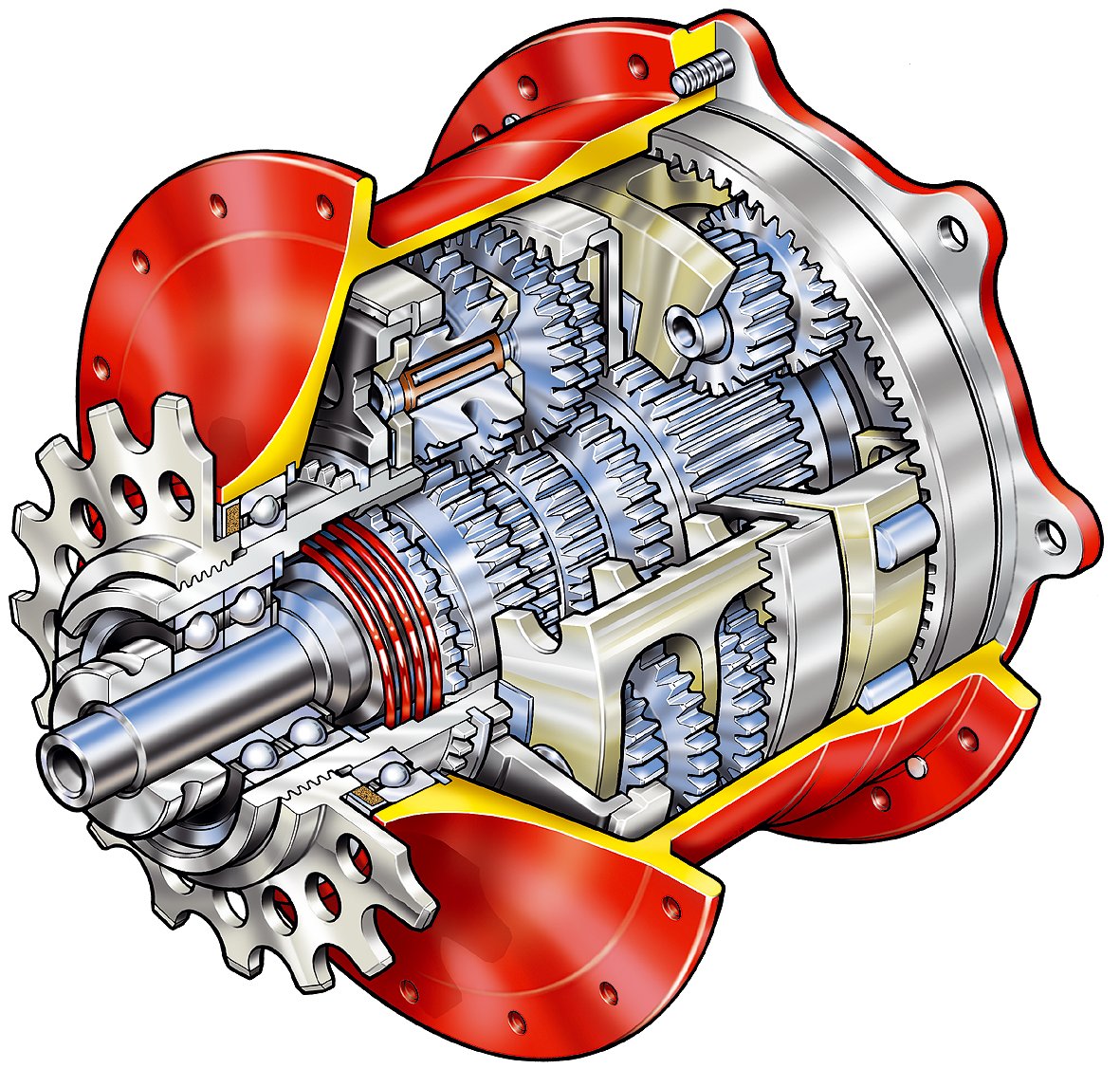
Image: Gearbox — Rohloff AG (gfdl).
To a bearing engineer, surface finish is not cosmetics - it is a load-carrying, lubrication-controlling, noise-determining property. The last two machining operations, grinding and superfinishing, decide it.
After heat treatment the ring is too hard to cut, so it is ground. Face, outer-diameter, raceway (track) and bore grinding each control specific features: ovality, roundness, taper, eccentricity and roughness. Modern CNC grinders hold sizes to roughly ±1 µm, and raceway profile error is typically held within a couple of micrometres so the loaded contact area is even.
Superfinishing (sometimes called superfinishing stone polishing or micro-finishing) uses fine abrasive stones under low pressure with oscillation to remove the microscopic peaks left by grinding. It produces a characteristic cross-hatch and drives raceway roughness down to Ra ≤ 0.05 µm. The benefits are concrete: better lubricant film retention, lower friction and running temperature, reduced vibration and noise, and longer rolling-contact fatigue life.
As a rule of thumb, grinding leaves raceways around Ra 0.1-0.2 µm while superfinishing takes them below 0.05 µm. Balls are taken even further: after hard grinding they are lapped between cast-iron plates to roundness errors under 0.5 µm and surface roughness near Ra 0.01 µm, reaching precision grades such as G10-G5.
At KMK Bearing (SINO BEARINGS, KMK brand) these principles guide every order we manufacture in Chengdu, China. Our in-house process chain - forging, heat treatment, precision grinding, superfinishing and cleanroom assembly - is built to the standards described above, whether the part is a standard catalog bearing or a custom-engineered solution.
Discuss your application with kevin@sinoti.com or browse our bearing catalog.
SINO BEARINGS (KMK) - Perfect Quality -- Great Service -- Customized.
Source: SINO BEARINGS
This article is prepared by the SINO BEARINGS (Sinoti Tech) engineering team, based on published bearing standards (ABEC / ISO P0–P2), material datasheets, and field application experience across industrial, food, medical and aerospace uses. For manufacturer background, certifications and facilities, see our About page.
Related articles:
Ceramic Bearings Maintenance and Failure Prevention Guide -K Spherical Roller Bearings FAQ: Answers Buyers and Engineers A Study in Rolling Guides: Sustaining Accuracy and Boosting Miniature Bearings Maintenance and Failure Prevention Guide Pillow Block Bearings FAQ: Answers Buyers and Engineers Ask


