

 TECHNOLOGY
 PRODUCTS
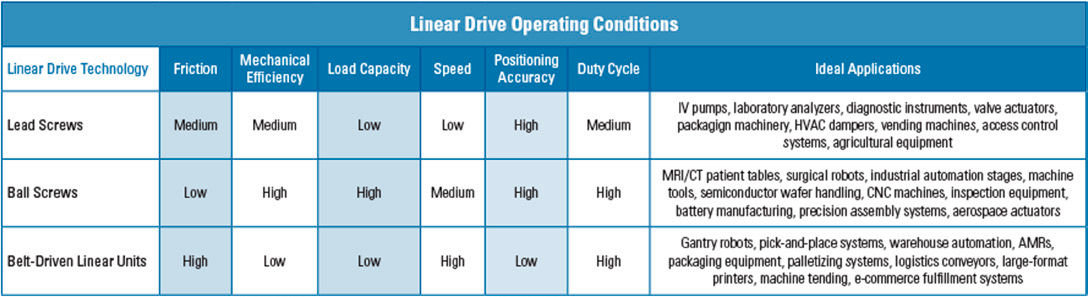
Speed and stroke begin to define the practical limits of each drive technology. A screw-driven system operating over a relatively short travel may perform exceptionally well but increasing the stroke while maintaining the same operating speed can introduce critical speed limitations as the screw length increases. At that point, a belt-driven solution may become the more practical option, not because it is inherently better, but because it is better suited to the application's combination of travel and velocity. Looking at these requirements together allows unsuitable technologies to be eliminated early, simplifying the drive technology selection process before detailed sizing begins (Figure 2).
Operating pattern is equally important. An axis that indexes only a few times each hour places very different demands on a drive system than one operating continuously throughout every production shift—even when load and travel remain the same. Likewise, specifying positioning accuracy beyond what the machine requires may increase cost without improving performance, while underestimating that requirement can compromise the finished design. The objective is to match the capabilities of the drive system to the machine's actual requirements, rather than specifying for performance the application does not need.
Matching the Drive Technology to the Application
Once the operating requirements are understood, the range of suitable drive technologies has usually narrowed considerably. Rather than comparing every available option, determine which solution offers the best balance of performance, service life and cost for the operating requirements that have been established. Although there is often some overlap between technologies, each has characteristics that naturally suit particular types of applications.
Long-stroke, high-speed applications are a good example. Engineers from a motion control solutions manufacturer recently worked with a customer developing a camera system that needed to travel more than 20 feet at several meters per second. Those requirements immediately changed the drive technology selection process. A screw-driven system of that length would be constrained by critical speed limitations as rotational speed increased, making it more difficult to achieve the required performance. A belt-driven actuator, however, could accommodate both the travel distance and operating speed while maintaining the motion profile the application demanded. Similar considerations apply to gantries, transfer systems and other applications where long travel and high velocity are more important than achieving the highest possible positioning accuracy.
Lead screws suit a different range of operating conditions. Because the nut slides along the screw rather than rolling on recirculating ball bearings, lead screws operate with greater friction and lower mechanical efficiency than a ball screw. This characteristic limits their suitability for higher loads and continuous, high-speed operation, but it can also offer advantages where those demands do not exist. Compact medical equipment, laboratory instruments and desktop automation systems often place greater value on quiet operation, simple construction and reduced maintenance than maximum speed or load capacity. Polymer lead screw nuts can also operate with minimal lubrication, while certain screw and lead combinations can provide self-locking characteristics that help resist backdriving in vertical applications.
Where higher loads, greater positioning accuracy and demanding duty cycles are combined, ball screws frequently become the preferred solution. Their rolling contact delivers high mechanical efficiency, reducing friction and the torque required from the motor while supporting heavier loads and repeatable positioning performance over long operating lives. A vertical manufacturing axis, for example, may require the combination of high load capacity, speed and precision that naturally favors a ball screw. That high efficiency also makes ball screws susceptible to backdriving, however, so vertical applications will typically require an appropriate braking solution to hold the load if power is removed. The final specification is therefore driven by the complete operating requirement rather than the characteristics of the screw alone.
Looking Beyond Basic Performance Specifications
Once the primary motion requirements have narrowed the range of suitable drive technologies, engineers can evaluate the remaining options against a broader set of application considerations. Service life, efficiency, maintenance requirements and environmental conditions may not determine the initial technology choice on their own, but they can become decisive when several solutions satisfy the basic load, speed, stroke, duty cycle and positioning requirements. These factors should therefore be considered as part of the same application-led selection process rather than as isolated specifications.
One of the most common misconceptions is that remaining within a published load rating automatically means a system has been sized correctly. In reality, the load rating simply indicates that the product is capable of carrying that load. Service life decreases as loading increases, so two separate systems may both satisfy the basic load requirement while offering very different operating lives. An application engineer may therefore recommend moving to a larger screw or actuator even though the original selection remains within its published capacity. The larger system may require more installation space and increase initial cost, but it can also provide the service life the machine requires. Equally, where a shorter design life is acceptable or installation space is restricted, a smaller solution may still represent the most appropriate engineering decision. The objective is to achieve the required service life while balancing performance, package size and overall machine requirements.
Environmental conditions can have an equally significant influence on the final specification. Exposure to moisture, washdown procedures, abrasive contamination or corrosive chemicals may require anodized components, stainless steel hardware, plated screws or enhanced sealing arrangements. These considerations should be identified as part of the original application review rather than addressed after the drive has been selected. A system that performs exceptionally well in a clean manufacturing environment may require a very different specification when installed in food processing, outdoor equipment or other demanding operating conditions. Considering these factors from the outset helps ensure the selected system will perform reliably throughout its intended operating life.
Using Software to Support Selection
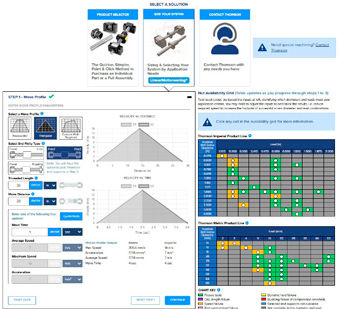
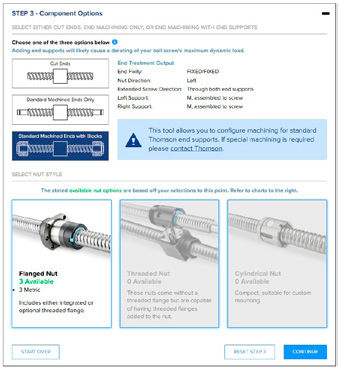
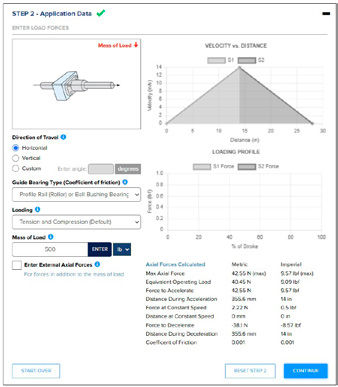
Modern sizing software has become an important part of the selection process because it allows engineers to evaluate application data against a wide range of products quickly and consistently. Entering parameters such as load, stroke, travel speed, force direction and applied moments enables the software to eliminate unsuitable options, compare expected service life and identify technically viable solutions far more efficiently than manual calculations alone (Figure 3).


